The Friction of Watching Basketball in Canada, and a Saturday With AI
Reducing small frictions with AI: I built a guide to help Canadian NBA fans work out which games they can stream, and what’s worth paying for.

If you want a post about AI reducing friction (in this case very low stakes friction), keep reading below ⬇
Every fall, at the start of the NBA season, the same questions show up on Reddit. Do I need both TSN and Sportsnet+ to watch the Raptors? Is NBA League Pass worth it in Canada? Why is the game I paid to watch blacked out? Someone answers, people new to the game are surprised, someone suggests a VPN, and the thread simmers down. Judging by the clickbait in my feed right now, it is a popular pain in the ass to solve. It bothers me every year, because I don’t have cable and I want my NBA-watching dollar to go as far as it can.
So this year I made a web page that answers it: Who Owns the Game You Want to Watch? Click here to go straight to the guide.
It takes the 2026–27 season game by game, from October 31, and shows who holds the right to show each game in Canada, what each service costs, and what a fan who streams instead of paying for cable gets for the money.
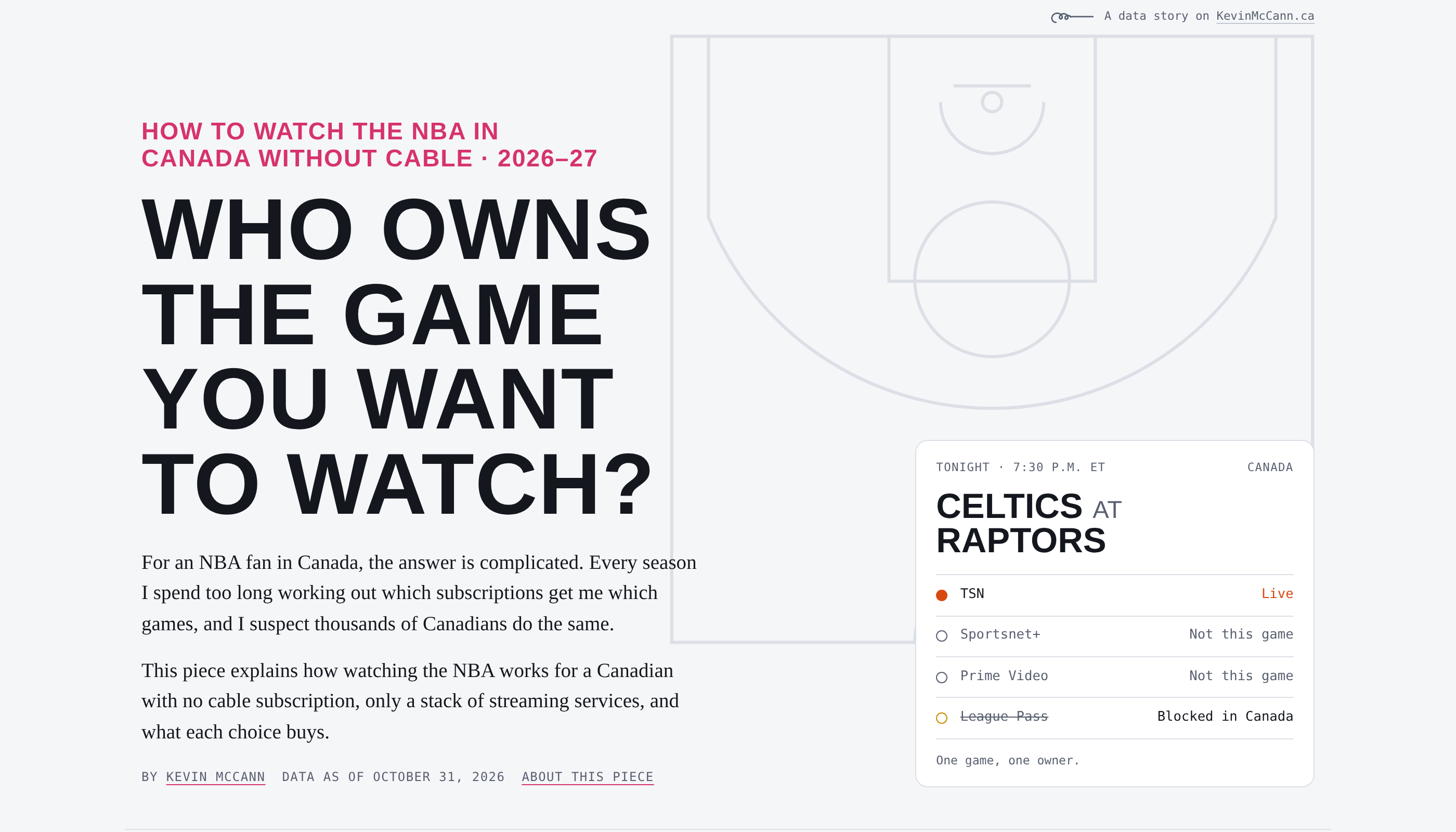
If you only came for the answer, here is the short version, organized by the three most common frustrations (but the page answers a lot more than these three bullets):
- To watch every Raptors game without cable, you need TSN, Sportsnet+ and Prime Video. TSN and Sportsnet split the Raptors almost evenly, and Prime has two. The page shows where every game lands.
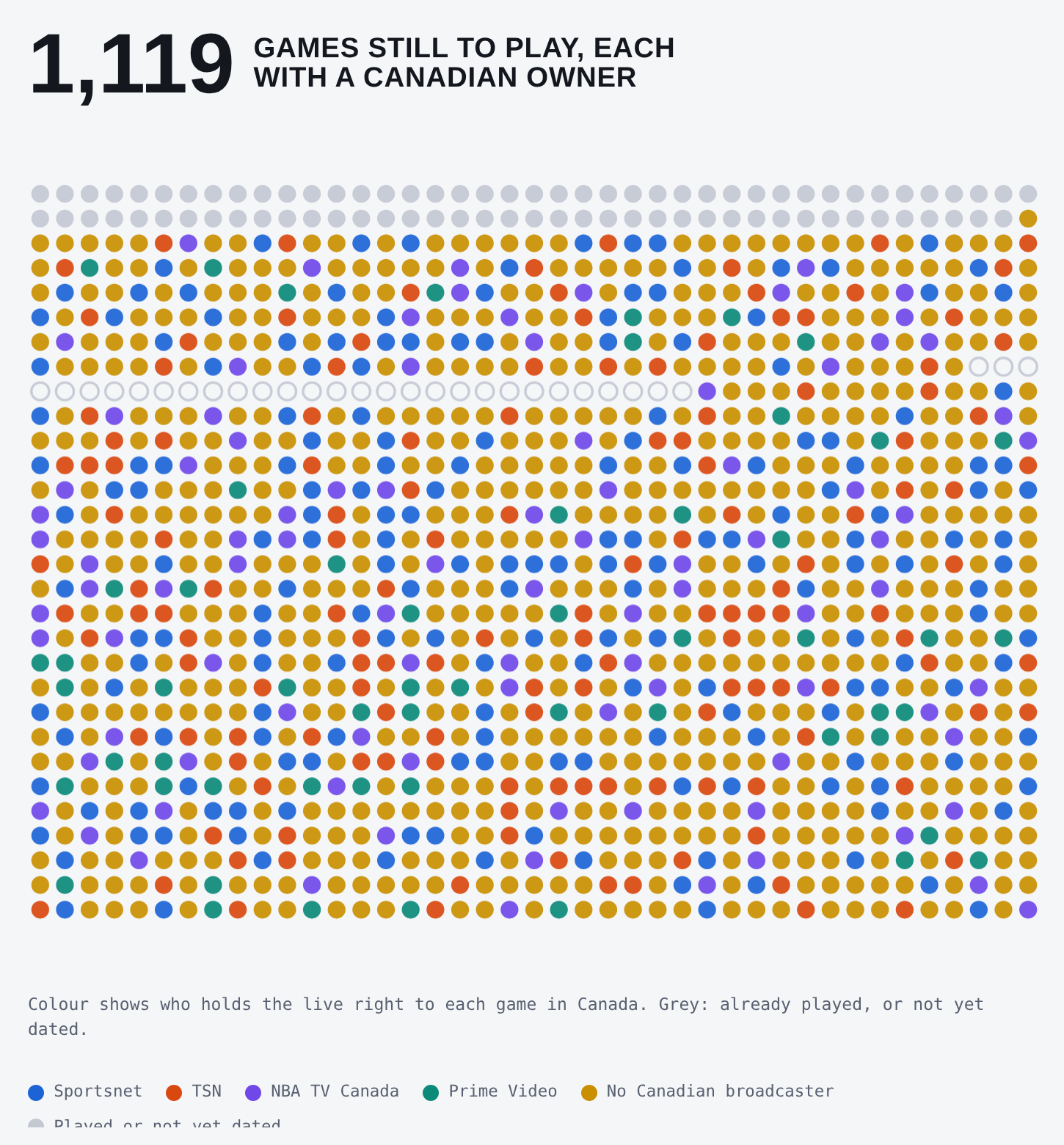
- NBA League Pass in Canada doesn’t show the whole league. It shows the games no Canadian broadcaster bought: 635 of the 1,119 still to play as of October 31. If TSN, Sportsnet or Prime holds a game, League Pass blacks it out, whether or not you subscribe to them. That is why every Raptors game is blacked out on League Pass. The best games, between the most popular teams, are split between the two big broadcasters, and getting all of them means paying for both.
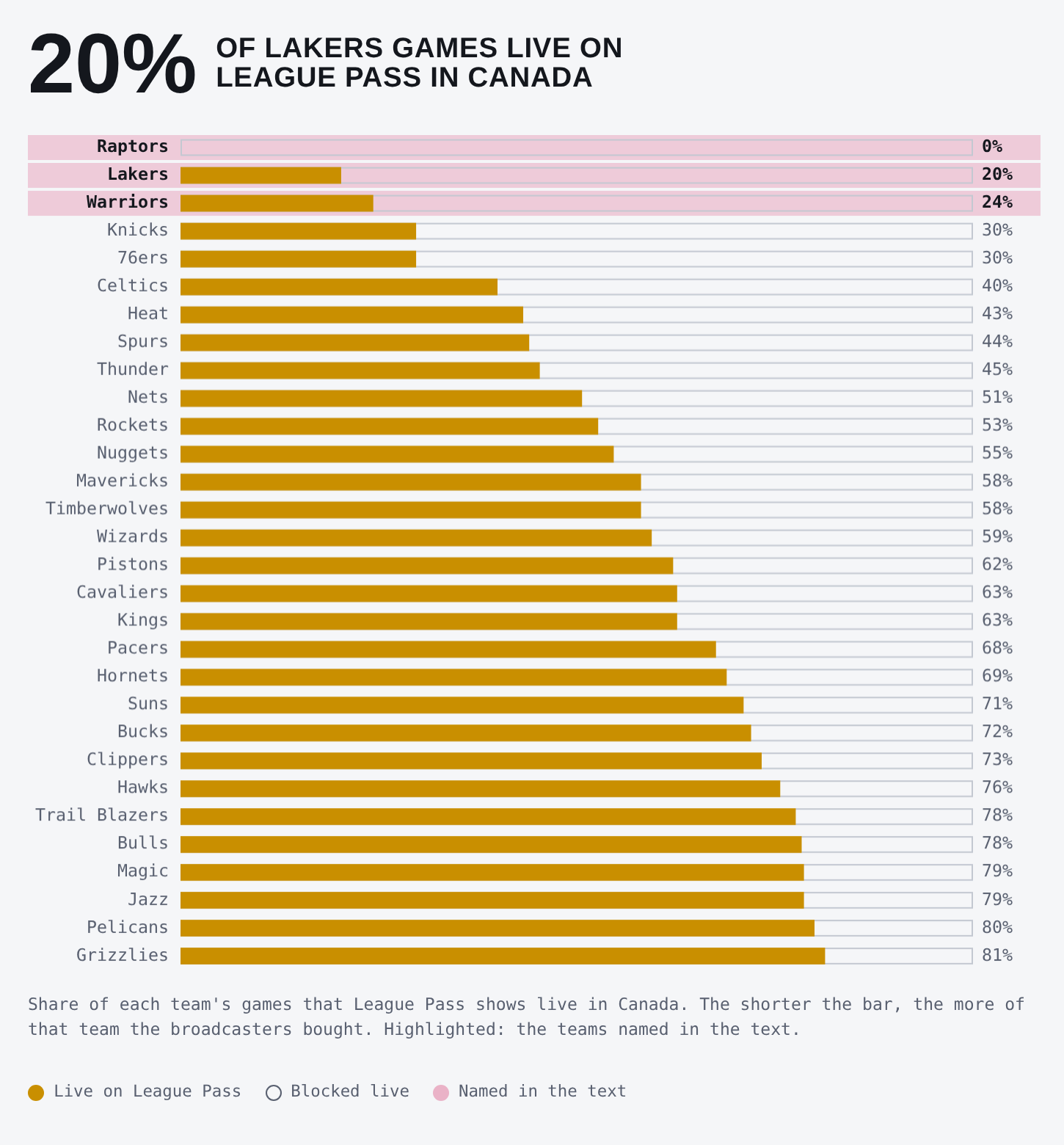
- The more popular the team, the less of it League Pass shows. For viewers in Canada, it carries 20 per cent of the Lakers’ games and 81 per cent of the Grizzlies’. The page breaks it down for every team.
I made the page mainly for the viewer in Canada who has never sat down to work this out, or who bought League Pass expecting the whole league and got the games nobody else wanted. (I did that once, when I first moved here from the U.S.) It’s for the reader who realized one day that watching basketball in Canada with intent requires spreadsheet analysis and data hygiene. The data is fairly easy to get; making sense of it is not exactly a walk in the park. Or it wasn’t, before AI.
I also made it, and wrote it up, because I’m interested in what AI means for our daily lives, habits and behaviour, and it’s part of my job to adapt work to the new terrain of AI. The friction of solving a problem—especially the friction thrown off by the bureaucracies orbiting it, intended or not—can get a lot lighter with AI in our lives. That doesn’t mean turning a blind eye to the negative first- and second-order effects of AI—like making people dumber. It does mean, potentially, more ease and creativity for people who can put it to use.
Two hours, spread across a Saturday
On Saturday morning, over coffee, I recorded a rambling voice note about the problem: the games, the channels, the blackouts, the locked-in choices of the Canadian NBA viewer. Apple News had prompted it, serving me the clickbait it serves every year to the disadvantaged Canadian NBA viewer. I pasted the transcript into Claude and asked it to work like a data storyteller and help me make my own streaming choices this season. Mostly, I wanted to know the best deal for watching Wemby play. (I usually wait until December to sort this out.) Between weekend work-work, walking the dog, raking too many leaves and getting groceries, the page was live on this site by evening. I didn’t really plan to build it until it was half done.
I created most of the script by voice, worked out the story beats, set the framing and guided each draft. Because of how I work with AI, and the personal context I have in place, it could suggest ideas without taking over the direction. Sometimes I adopted its suggestions, sometimes I didn't. I made the decisions along the way. I wanted a story around the facts, the numbers right, and the whole thing clear. I've adore good data visualization and storytelling. I'm a regular reader of The Pudding, the New York Times graphics stories and Information is Beautiful, and I've worked with talented data storytellers steeped in both the old (pre-AI) and new web (with AI).
For this project, Gemini and Claude did the data analysis and the build. They read the NBA’s Canadian broadcast schedule game by game, matched Prime Video’s games, checked prices, and wrote the code that sorts and animates 1,230 dots. Along the way I learned things Google Search hadn’t told me. I had assumed Prime only carried games TSN and Sportsnet passed on; Prime’s games turned out to be its own, on no other service. Catching that, checking the AI’s work in turn, and seeing what story the data told took most of the time. It was fun, and none of it required sitting at a desk.
Not long ago, a piece like this could have needed a data analyst, a designer and a developer, or a newsroom with an art director. It would have taken hours and hours, and an inordinate amount of front-end web talent. In another life I was that front-end talent, so I know. On a Saturday in October (Halloween, as it happens), it was a piece of cake.
This leaves two ideas in tension. More is possible, in less time, at good quality. And the people who used to do this work could be displaced. Is this replacement or adaptation? I come down on the side of adaptation, and this piece is why. I knew what to ask for and what to check because I had built this kind of thing before, or overseen its building. Whether that holds for someone starting out in information design, I’m not sure. I hope the tools add to what a person can do without taking away the way they learn to do it. Tricky.
“What the internet did to information, this [AI] does to a certain kind of work, a certain kind of admin… hassle, and paperwork, and aggravation and friction… it brings liquidity and transparency and removes friction from that in the way that the internet did…
…AI will just automate away that thing that was kind of a pain and you won’t have to do that anymore. And then you’ll kind of forget that there was a time that you had to do that.”
— Benedict Evans, Another Podcast, “The Last Friction”
A lot of spending, and a lot of business models, depend on things being just complicated enough so that people don’t bother, points out Benedict Evans, the technology analyst and essayist. The health plan nobody compares because nobody has the time; the credit card rewards nobody tracks. Evans remembers applying for his son’s kindergarten in San Francisco, a process so complicated it took hours of research, even though making sense of systems is what he does for a living. I had exactly this trying to navigate public schools in Washington, D.C. He goes on:
“Bureaucracy is a regressive tax… bureaucracy privileges people [whose] education and background and experience is about managing complexity… and it penalizes people whose experience and expertise isn’t that.”
Sometimes bureaucracy is insidious and consequential, and sometimes it is watching the NBA in Canada. With AI’s help, the page removes the friction of finding the games you want to watch. Evans describes a world where an agent does this kind of work for each of us at the moment we need it, even if we haven’t asked. It’s not quite here yet, but having started to use a ChatGPT Dot, I think it’s a corner or two away.
It would be easy to read all this as hollow “anyone can make anything now” cheerleading. Evans has been arguing against that cheerleading in recent months, particularly about B2B SaaS. In another episode, he and his co-host, Toni Cowan-Brown, point out that most people in most companies aren’t tool-builders. AI lowers the threshold for making things; it doesn’t give us the expertise to decide what to make, or why. In a world of answers, and of infinite tools made by everyone and their agents, I think the premium is on scarce expertise. If execution is cheap, what is left for people is judgment, temperance, wisdom and nuance. Ted Shelton makes a related argument in an essay published the day I built this, breaking what we bring into data, process and taste. At least for now, and maybe for a long time as our radar and sensibilities change, handing work to AI without taste, judgment and intent will produce what Shelton calls “fluent and forgettable” output.
That is why my two distracted hours worked. I already knew the problem, who the page was for (me, really), what I wanted, and what a good explainer looks like, from a long career in communications and story. The AI took on the parsing, counting and coding I could never be trusted to do today, nor would want to do. But I did want the result.
Writing this post took twice as long as the page, over more sittings. The writing is the hard part. I wrote the first draft and took some structural suggestions from AI, and I kept picking at it. But AI hadn’t listened to the podcast, and it didn’t share my irritation at missing great games, or at paying $35 a month to get half the good ones. AI cropped the screenshots; I’ve paid my cropping dues many times over, and I don’t lament the loss.
So what should a Canadian NBA fan pay for?
That’s up to you, and who you want to watch. For the Raptors, the biggest matchups and the league’s best-known teams, you need TSN and Sportsnet+, about $65 a month for the two, cable or no cable (which is more than I want to pay). If you follow a team the two Canadian broadcasters passed over, League Pass is good value.
Either way, it is a market working the way it was designed to, and part of its cost is the effort of understanding it: the regressive tax of a corporate bureaucracy tuned to what it thinks it can extract from the average Canadian NBA fan’s wallet. I hope the page helps you take back some agency over that bureaucracy and make a more informed decision about your streaming dollars, as it did for me.
The post above ↑ is not the guide. Go to the guide → →